How to Order Steak at a Gainesville Steakhouse
Aug 18, 2026To order steak well, make four decisions in order: the cut, wet-aged or dry-aged, the temperature, and the accompaniment. Pick the cut by how you want to eat, a filet for tenderness or a ribeye for flavor. Order medium rare unless you have a reason not to, then put something bright on a fatty cut and something rich on a lean one.
There is a particular silence that falls over a table when the steaks come up. Somebody has been reading the same page for four minutes and has narrowed it down to nothing. Ordering a steak well is not difficult, but it does involve four decisions stacked on top of each other: which cut, wet-aged or dry-aged, what temperature, and what goes on top. Get those right and the rest of the night takes care of itself. Here is how we would walk you through it.
Start with how you want to eat, not with the price
The most common mistake at a steakhouse is reading the menu as a ranking, where the expensive cut must be the best one. It is not a ranking. It is a set of genuinely different eating experiences, and the right answer depends on your mood tonight.
Ask two questions first. Do you want a steak that tastes intensely of beef, or one that is tender above everything else? And is this a plate of your own, or a cut the table will share? Those answers cut a long list down to two or three candidates, and they matter more than any number printed next to the name.
The cuts, and what each one is actually for
Every steak comes off a different part of the animal, and that is the whole story. Muscles that work hard build flavor. Muscles that do very little stay tender. Nothing is better than anything else, and the pleasure of a steakhouse is choosing your own position on that trade. The short version of the wet-aged Prime and Wagyu section of our menu:
- 8oz filet. The most tender cut on the animal and the mildest tasting, because the muscle it comes from barely moves. Order it when texture matters more to you than a big beefy flavor. The 12oz bone-in filet is the same muscle with the bone left on for more character.
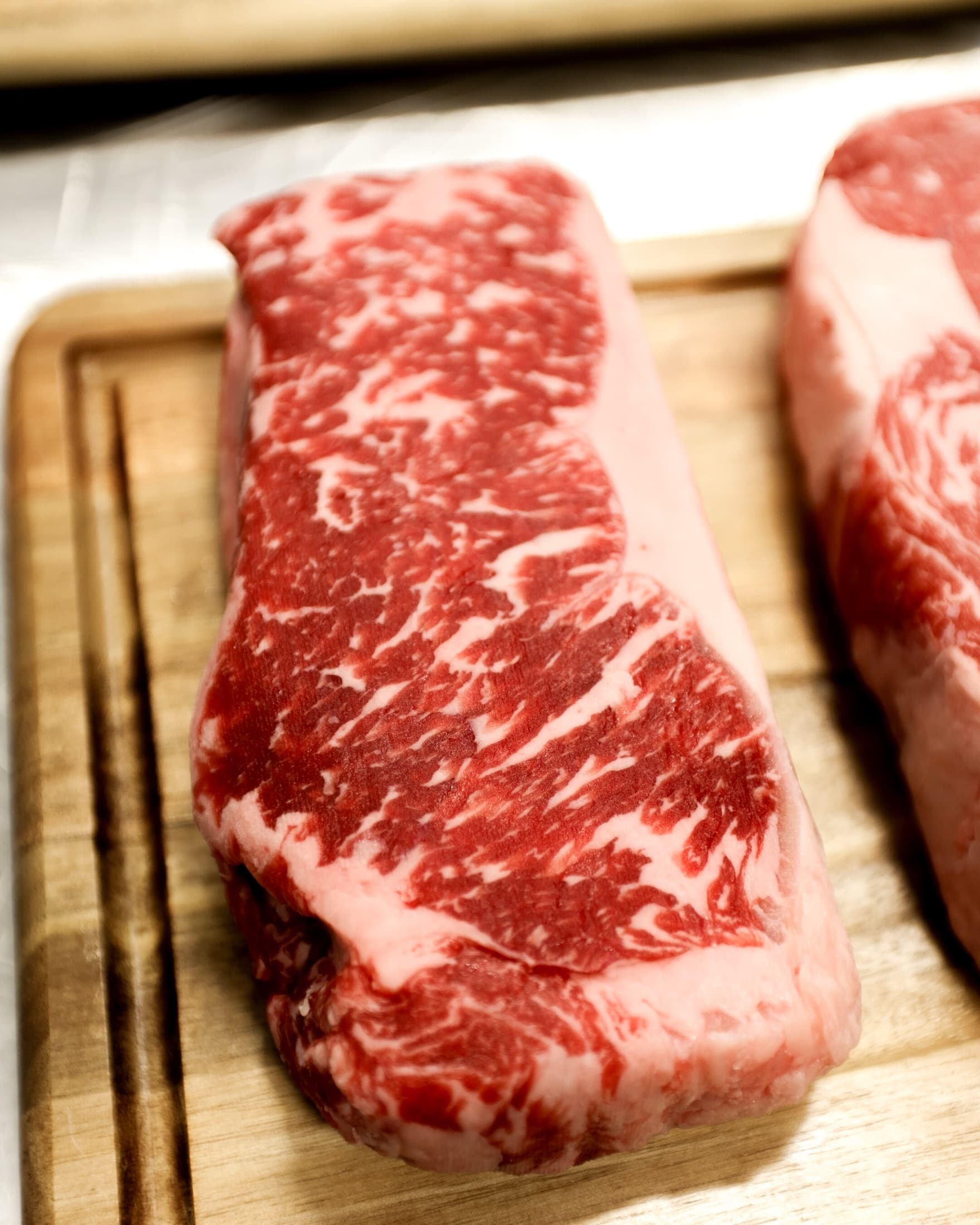
- 15oz ribeye. The middle of the menu in the best sense: heavy marbling through the muscle, a rich mouthfeel, and the flavor most people picture when they picture steak. If you have no idea what you want, this is the answer nobody regrets.
- 12oz spinalis. The cap that wraps around the outside of a ribeye, separated out and served on its own. Butchers famously keep this one for themselves. It eats like a ribeye turned all the way up.
- 15oz Wagyu strip. A strip loin from American Wagyu cattle, which carries far more fat inside the muscle than Prime does. Rich in a way that sneaks up on you around the fourth bite. We wrote a whole piece on what American Wagyu actually is.
- 32oz tomahawk. A ribeye left on a long frenched rib bone. This is a cut for two, and it is as much about the moment it lands on the table as it is about dinner.
Wet-aged or dry-aged
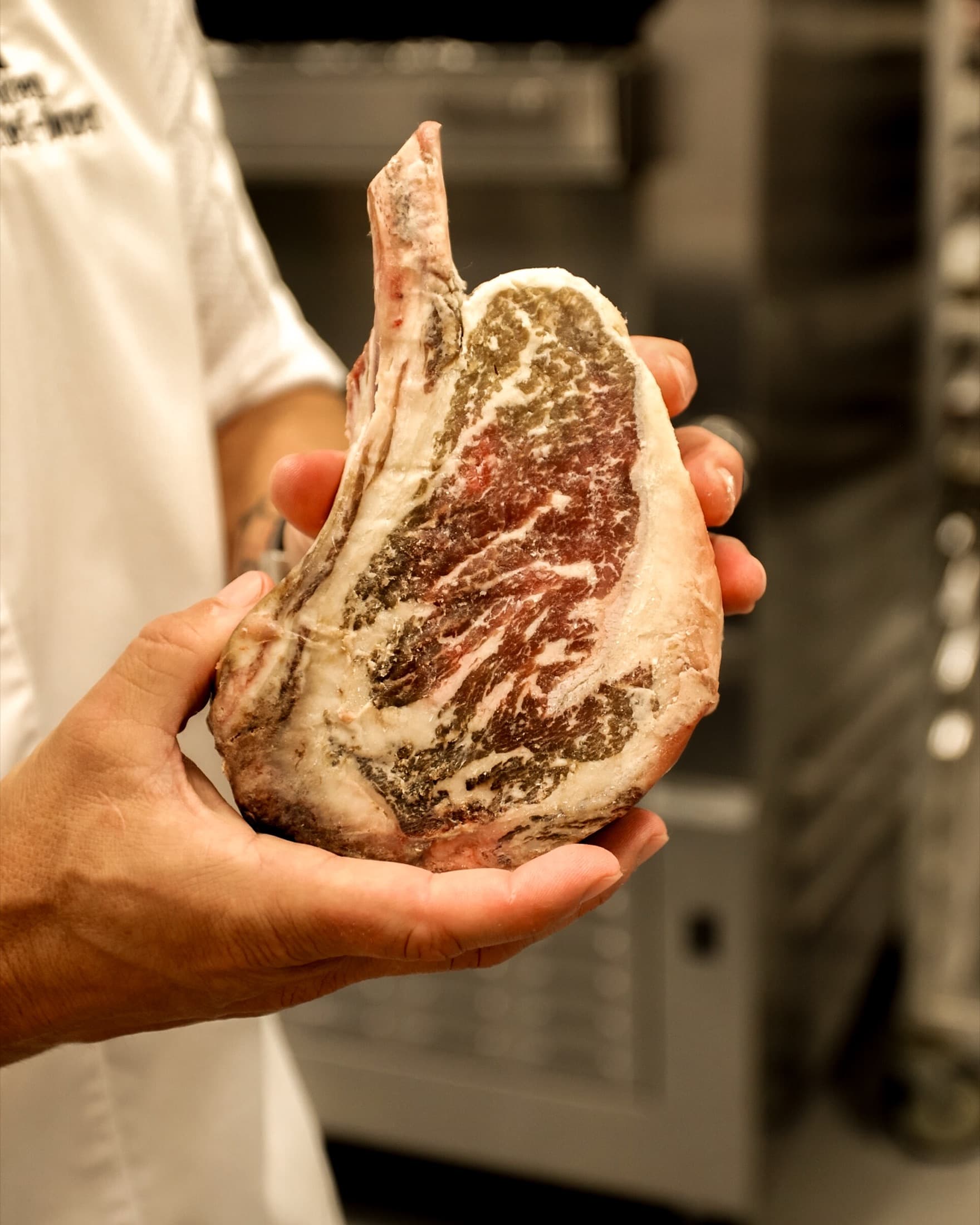
Below that list is a shorter one headed In-House Dry-Aged USDA Prime: a porterhouse, a cowboy ribeye, and a T-bone. This is the decision most guests do not realize they are making, and it changes the flavor of dinner more than the choice between a ribeye and a strip does.
Wet-aged beef, which is nearly all beef, ages in vacuum-sealed packaging. It tenderizes, it holds its moisture, and it tastes clean and straightforwardly of beef. That is what most people mean when they say they want a great steak.
Dry-aged beef sits uncovered in a cold room for a minimum of four weeks. Moisture leaves, the beef's own enzymes go to work on the connective tissue, and what comes out tastes deeper and nuttier, closer to browned butter or aged cheese than to fresh beef. You can see our room from the bar, behind glass. What four weeks of dry aging does to beef has a post of its own.
If you have never eaten dry-aged beef, order it. If you are ordering for somebody who believes all steak tastes the same, order it for them. And if you know you want clean beef and nothing else, stay on the wet-aged list without apology. Both lists are USDA Prime, the top grade the USDA awards, and Prime is a small share of the beef graded in this country.
The temperature question
This is where most steak dinners are won or lost, and it is the one decision you cannot take back. A steak can always go back on the grill. It can never come off it.
Our default recommendation is medium rare, and that is not snobbery. Medium rare is where the fat inside a well-marbled cut has softened and turned into flavor, but the muscle fibers have not tightened and pushed their moisture out. Past that, every degree costs you something you paid for.
Three things matter more than the general rule. The first is that the leaner the cut, the more temperature matters. A filet at medium well has very little fat left to protect it, while a ribeye at medium is still carrying plenty. If you prefer your steak cooked through, order a fattier cut and it will treat you better.
The second is thickness. A 32oz tomahawk pulled at medium rare arrives with a gradient running through it, more done near the outside and cooler in the center, so there is something in that steak for everybody. It is the smart order for a table that cannot agree.
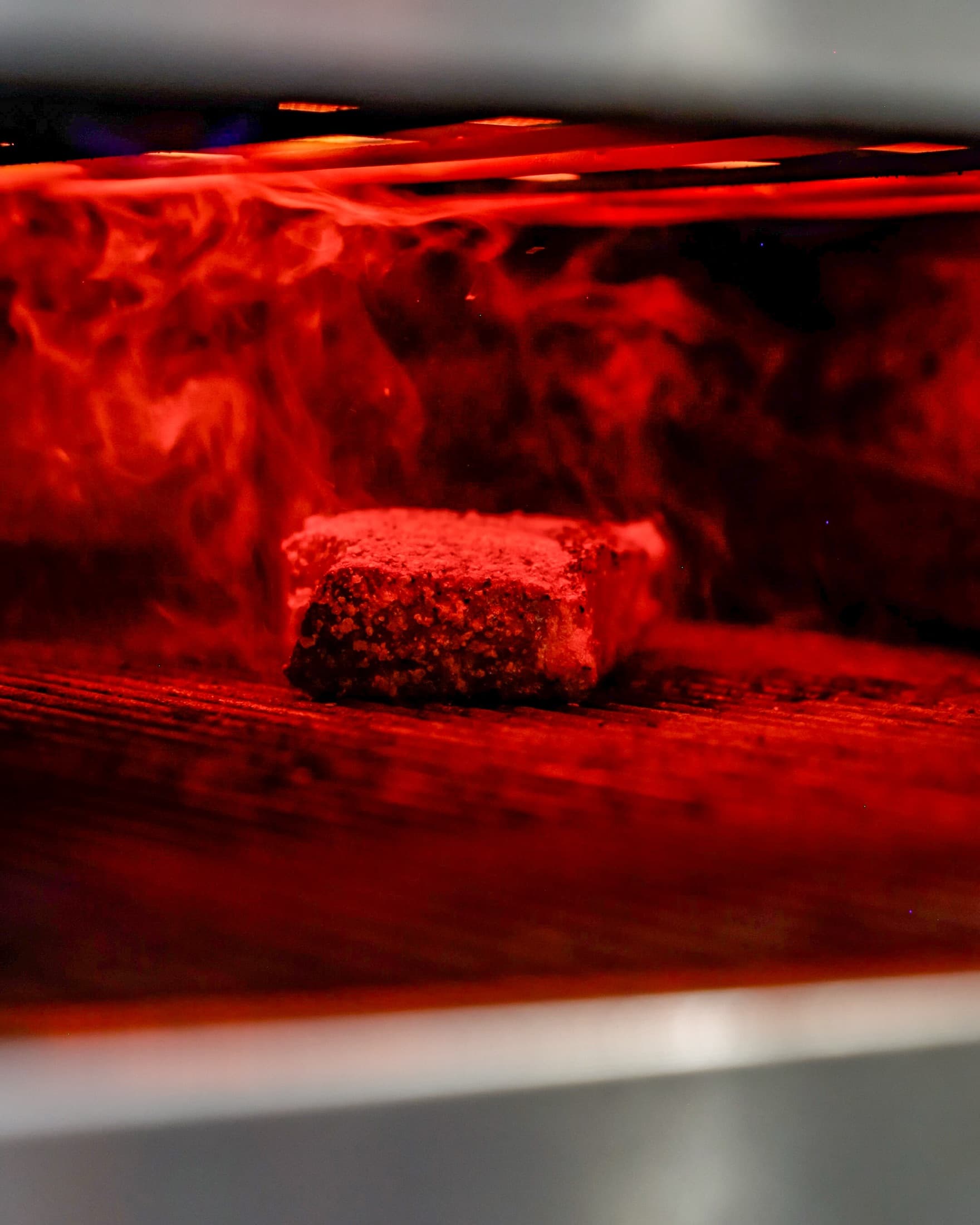
The third is that a steak keeps cooking after it leaves the heat. We sear on an infrared broiler that runs hotter than a conventional grill, which sets the crust fast and leaves the middle alone, and the kitchen pulls steaks a shade early on purpose so they finish on their own heat while resting. If yours lands just under where you asked, give it two minutes before you decide.
For the record, the USDA's safe minimum internal temperature for whole cuts of beef is 145 degrees followed by a three minute rest. Restaurants cook below that at the guest's request, which is what the asterisks on the menu are telling you.
A steak can always go back on the grill. It can never come off it. Order a shade rarer than you think, and let the rest happen at the table.
Accompaniments, and how to pick one
Every steak comes with your choice of accompaniment, and that list runs in two directions. The butters melt into the steak: citrus herb, calabrian chili, truffle, black garlic and herb, or bone marrow butter. The sauces arrive alongside, either bearnaise, rich and classic, or chimichurri, sharp and green and full of acid.
The rule worth carrying with you is to match direction rather than intensity. A fatty cut wants something cutting against it. A leaner cut wants something filling in what it does not already have.
- On a spinalis or a Wagyu strip, go bright. Chimichurri. The cut is handling the richness on its own.
- On a filet, go rich. Bone marrow butter or bearnaise gives a lean muscle something to lean on.
- On a dry-aged porterhouse, consider ordering nothing at all. Four weeks of aging is a flavor you specifically paid for, and truffle butter will sit right on top of it.
- On the wild game list, sharp beats rich almost every time. The game guide goes further into that.
Then there is the second column. You can add seared scallops, a lobster tail, a lobster cake, gulf shrimp, or salmon to any steak. The reason to do it is contrast rather than abundance: cold-water sweetness next to a charred crust is a genuinely different bite than either thing on its own.
Sides are shared, so order fewer than you think
Sides come family style here and they are not small. Two sides for two people is plenty. Three for four is usually right. Tables routinely order six and take half of it home.
Build that part of the plate by contrast too. If you have a heavily marbled cut with butter melting on it, put something green or acidic beside it: grilled asparagus, collard greens, roasted cauliflower. If you went lean, the lobster truffle mac and cheese or the whipped potato fills the plate out. The beef tallow fries go first no matter what anyone intended. Seasonal mushrooms are what we would put next to a dry-aged cut, because earthiness and age point the same direction.
Four things worth asking your server
What is in the dry-age room tonight. Those cuts are priced at market and the selection moves, so this is a real question with an answer that changes week to week.
What came in today. The fish feature and the soup rotate daily and never make it into print.
Which cut would you order. Servers here eat this food, and the honest answer beats any menu description.
Can we split a cut. Yes, for the big ones. A tomahawk or a porterhouse comes to the table carved and ready for a group to work through.
Three orders that work
For a first visit, alone or as a pair: the 15oz ribeye, medium rare, black garlic herb butter, grilled asparagus and beef tallow fries. Nothing in that order is a risk and all of it is good.
For somebody who already knows what they like: whatever is dry-aged that night, medium rare, no butter, seasonal mushrooms alongside, and a pour from the private barrel program next to it. Aged beef and aged whiskey run the same trick from different directions.
For a table of four or more: a 32oz tomahawk and a second cut to compare it against, four sides down the middle, and a bottle chosen with help. If the group is larger, the Executive Suite, our private dining room, seats up to 28 and the menu is set in advance. Blade Club members get 10 percent off food and beverage plus complimentary corkage.
However you order, come early if you can. Happy hour runs 4:30 to 6 at the bar and it is the least rushed part of the evening. We are at 126 Bradford St NE in downtown Gainesville, Georgia, and dinner is Tuesday through Sunday from 5 to 10 PM. Reserve a table on OpenTable, tell your server what you actually want, and order like you mean it.
Frequently Asked Questions
- What temperature should I order my steak?
- Medium rare is our default recommendation, because it is the point where the fat inside a well-marbled cut has turned into flavor without the muscle tightening and losing moisture. The leaner the cut, the more this matters. A steak can go back on the grill but it can never come off it, so order a shade rarer than you think.
- Should I order wet-aged or dry-aged steak?
- If you have never eaten dry-aged beef, order it: four weeks in our dry-age room gives it a deeper, nuttier flavor you will not get any other way. If you know you want clean, straightforward beef, stay on the wet-aged list without apology. Both are USDA Prime. Our post on why dry-aged steak tastes better explains what the aging changes.
- Which steak should I order on a first visit?
- The 15oz ribeye, medium rare. It has enough marbling to be forgiving, it tastes the way people expect steak to taste, and nobody regrets it. If you want something rarer to find elsewhere, ask what is in the dry-age room that night.
- Do steaks come with sides, or do I order those separately?
- Every steak comes with your choice of accompaniment, which is a butter or a sauce. Sides are ordered separately and come family style, so two sides for two people is usually plenty.
- What if somebody at the table does not want steak?
- The Chef's Menu runs from sea bass and scallops to lamb chops, a squid ink shrimp linguini, and a sous vide chicken, and there is a full raw bar. There is also a wild game list with elk, venison, bison, and pork. The full dinner menu has the rest.
- Can two people share one steak?
- Yes. The 32oz tomahawk is a cut for two, and the big cuts, a tomahawk or a dry-aged porterhouse, come to the table carved and ready to share. One large steak plus a second cut to compare it against is a good way to build a table. Reserve on OpenTable.